Leave Your Message

Top Rare Earth NdFeB Permanent Magnet Suppliers?

Choosing a Rare Earth Ndfeb Permanent Magnet supplier is not just a price comparison. Magnet grade, operating temperature, corrosion protection, dimensional tolerance, and production capacity can all affect performance in the finished assembly. A datasheet may look reassuring, but the magnet still has to work beside the actual motor, sensor, or actuator.

Industry reports help explain why supplier selection deserves care. The U.S. Geological Survey’s Mineral Commodity Summaries 2025 tracks rare-earth mine production and supply, while the International Energy Agency’s Global Critical Minerals Outlook 2024 examines concentration across critical-mineral supply chains. These reports offer useful context, but they do not certify individual magnet makers. Mine supply and magnet manufacturing are different steps. Details matter.

This guide compares suppliers through practical checks: available grades, manufacturing processes, quality documentation, customization, lead times, and support for testing. Buyers should ask for material specifications and inspection records, then confirm that sample magnets meet the application’s requirements. Small details count. A supplier’s quoted maximum energy product, for example, cannot replace testing under real temperature and load conditions. There is no universally best magnet. Rankings can also hide differences in factory capability, regional availability, and service; this comparison therefore treats supplier claims as points to verify, not proof of fit.
Top Rare Earth NdFeB Permanent Magnet Suppliers?

What Are Rare Earth NdFeB Permanent Magnets?

Rare-earth NdFeB permanent magnets are made mainly from neodymium, iron, and boron. Their tightly packed crystal structure creates a powerful magnetic field in a small volume. That makes them useful in compact motors, speakers, sensors, and wind-turbine generators. Some grades also contain dysprosium or terbium to help retain magnetism at higher temperatures. The exact recipe matters.

There are two common forms: sintered magnets, which generally offer stronger magnetic performance, and bonded magnets, which can be molded into detailed shapes. NdFeB magnets can corrode, and heat can weaken them, so coatings and operating-temperature ratings deserve attention. The U.S. Department of Energy’s 2022 Rare Earth Permanent Magnets supply-chain report describes NdFeB magnets as important components in modern technologies. The USGS Mineral Commodity Summaries 2025 estimates 2024 rare-earth mine production at 390,000 metric tons of rare-earth-oxide equivalent worldwide, including 270,000 tons in China. These figures describe mined material, not finished magnets—a distinction easy to miss.

Tips: Check the magnet’s grade, coating, dimensions, and maximum operating temperature. A strong magnet is not automatically the right magnet. Ask how performance changes under heat and repeated use.

Typical NdFeB Grade Maximum Energy Product (BHmax)

BHmax indicates a magnet’s maximum magnetic energy product; higher values generally mean stronger magnetic performance for a given magnet volume. The ranges shown are typical grade-level values in megagauss-oersteds (MGOe), not supplier rankings. Specifications can vary by manufacturer and product.

How Are NdFeB Magnet Suppliers Evaluated?

Evaluating an NdFeB magnet supplier starts with the magnet’s job, not a sales brochure. Ask for measured remanence, coercivity, and maximum operating temperature for the specified grade. These values help indicate whether a magnet can meet the design’s magnetic and thermal demands. Check the test conditions, too. A number without its method or temperature is hard to compare.

Consistency matters. Request inspection records for dimensions, coating thickness, and magnetic performance across production batches. For a small component, a fraction of a millimeter can affect assembly. Ask how the supplier manages raw-material variation and handles rejected parts. Then review a sample under conditions close to actual use. Samples can pass while later batches drift. That risk deserves attention.

A capable supplier should explain trade-offs clearly. Higher coercivity, for example, may suit heat-exposed applications, but the best choice depends on the full design. Discuss corrosion protection, machining limits, packaging, and delivery lead times. Traceable documentation can support quality checks, though paperwork alone proves little. Look for answers backed by test data and practical engineering experience. No single score tells the whole story. A careful evaluation may still leave questions, and that is worth admitting.

Leading Global NdFeB Permanent Magnet Suppliers

Leading global NdFeB permanent magnet suppliers serve industries that need strong magnetic performance in compact designs. Their capabilities vary: some focus on high-volume production, while others handle custom shapes, coatings, or tighter tolerances. A useful comparison looks beyond price. Check the magnet’s grade, operating-temperature range, dimensions, coating, and test documentation. Ask how samples are inspected and whether production batches can be traced. Fit matters. A magnet that meets a headline strength rating may still fail in a hot motor or corrosive environment.

Supplier reach also depends on reliable communication, stable quality controls, and practical shipping support. Request a drawing review before ordering, especially for thin rings, small holes, or unusual geometries. These features can complicate manufacturing. Ask for inspection results tied to the agreed specifications, not just general product claims. Even a careful review can miss something; I would verify critical measurements on incoming samples.

Tips: Share the application temperature, nearby materials, expected load, and environment when requesting a quote. Compare samples against the same criteria. Small gaps count. If requirements change, confirm the revised specification in writing before production.

What Products and Industries Do These Suppliers Serve?

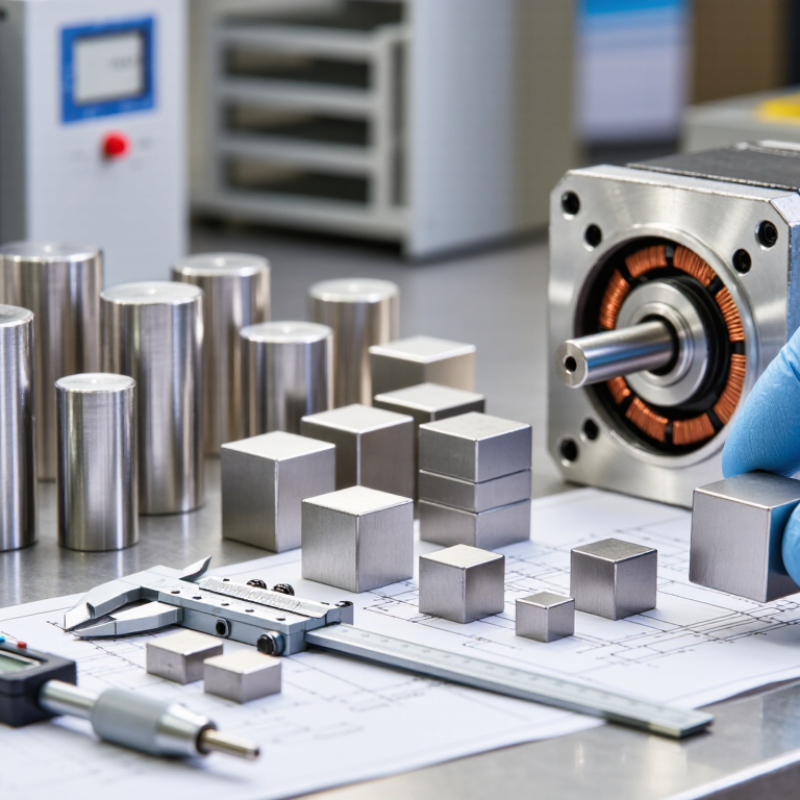
NdFeB magnet suppliers serve manufacturers with standard blocks, discs, rings, and arc segments, as well as custom-ground shapes. Many provide different magnetic grades, protective coatings, and magnetized assemblies. Nickel-based coatings are common, while epoxy may suit some damp environments. The right choice depends on more than pull strength. Engineers also check operating temperature, corrosion exposure, dimensional tolerances, and the direction of magnetization. Small details matter.

These products appear in electric vehicle motors, factory servos, robotics, wind generators, and compact electronics. In a motor, curved segments may fit around a rotor; in a sensor, a tiny disc can help detect position. Suppliers may also support loudspeakers, pumps, and certain medical equipment, where design requirements differ sharply. Still, catalog data can look cleaner than real operating conditions. Heat, vibration, and nearby steel parts can change performance. Requesting material data, coating details, and sample measurements helps buyers compare options. A prototype test is useful, even when the drawing seems complete. Some specifications are easy to overlook.

How to Choose the Right NdFeB Magnet Supplier?

Choosing the right NdFeB magnet supplier starts with your application, not a catalog. Define operating temperature, dimensions, load, environment, and assembly method. A magnet near a motor coil may face heat and reverse fields, so room-temperature pull tests alone can mislead. Ask for Br, Hcj, BHmax, dimensional tolerances, and test conditions. Compare results measured on the same basis. Details matter.

Request samples made to the intended grade, shape, and coating. Inspect them with the fixtures used in production, checking magnetization direction, fit, surface defects, and consistency. Ask for lot-level inspection records, calibration details, and traceability. A polished certificate without clear test methods offers limited evidence. Discuss lead times, minimum quantities, packaging, and how deviations are handled. A capable engineer should explain trade-offs, not merely promise the strongest grade. Be cautious of unusually broad claims. Even careful suppliers cannot eliminate every variation, so set measurable acceptance limits and agree on a corrective-action process before volume production.

Top Rare Earth NdFeB Permanent Magnet Suppliers? - How to Choose the Right NdFeB Magnet Supplier?

Selection Dimension Industry Reference / What to Check Questions to Ask a Supplier Why It Matters
Magnet grade Common sintered NdFeB grade families include N, M, H, SH, UH, and EH. Higher grade numbers generally indicate higher maximum energy product, not automatically better performance in every application. Can you provide the grade’s full magnetic-property data and a material certificate for the production lot? The correct grade depends on the required field, dimensions, operating temperature, and magnetic circuit.
Temperature capability Typical maximum operating-temperature classes are approximately 80°C (N), 100°C (M), 120°C (H), 150°C (SH), 180°C (UH), and 200°C (EH). Actual limits depend on the magnet, geometry, magnetic circuit, and operating conditions. What temperature limit do you warrant for this part in our operating conditions, and can you provide temperature-related demagnetization data? A magnet can lose performance if its temperature or opposing magnetic field exceeds its design limits.
Magnetic properties Compare remanence (Br), coercivity (Hcb), intrinsic coercivity (Hcj), and maximum energy product (BHmax) against the application specification. Confirm units and the applicable test method. Will you report measured values by lot, and what are the agreed acceptance limits and test conditions? Grade labels alone do not confirm that a delivered batch meets the required performance.
Coating and corrosion protection Common finishes include Ni-Cu-Ni, zinc, and epoxy. NdFeB magnets can corrode; coating choice should suit the environment and handling requirements. What coating thickness and corrosion-test results can you document? Is the coating suitable for our humidity, chemicals, and assembly process? A suitable coating helps protect the magnet and maintain product reliability in service.
Dimensions and tolerances Sintered magnets are brittle and are commonly machined by grinding. Specify dimensions, tolerances, chamfers, flatness, and surface finish on the drawing; achievable tolerances depend on geometry and process. Can you review our drawing for manufacturability and provide an inspection report for critical dimensions? Clear drawings and capability review reduce fit, assembly, and breakage problems.
Magnetization and polarity Magnets may be supplied unmagnetized or magnetized in specified directions, including axial, diametric, or multipole patterns. Define polarity and magnetization direction in the drawing. How will you verify magnetization direction, pole pattern, and polarity before shipment? Incorrect magnetization can make an otherwise dimensionally correct part unusable.
Quality management and traceability Review the supplier’s current quality-system certificate, inspection process, lot traceability, nonconformance handling, and change-control procedure. Verify certificates with the issuing body where needed. Can each shipment be traced to its material and inspection records? How are process or material changes communicated? Documented controls support consistent production and faster resolution of quality issues.
Sampling and validation Before production release, evaluate representative samples for dimensions, magnetic properties, coating, assembly fit, and performance under intended conditions. Can you provide samples made with the proposed production process and support first-article approval? Sample validation helps identify design or process issues before larger orders are placed.
Supply and commercial terms Compare quoted lead time, minimum order quantity, sample charges, packaging, shipping terms, capacity, and continuity plans using the same drawing and forecast. What are the quoted lead time and order assumptions, and how do you manage supply disruptions or raw-material changes? A technically suitable magnet also needs a dependable supply plan and transparent commercial terms.

Note: Temperature classes and process descriptions are general industry references, not guarantees for a specific part. Confirm current specifications, test methods, and acceptance criteria directly with the supplier.