Leave Your Message

Who Is China Top Rare Earth NdFeB Permanent Magnet Supplier?

China has become a major manufacturing center for Rare Earth Ndfeb Permanent Magnet products. Its suppliers serve electric vehicles, wind turbines, industrial motors, sensors, and medical equipment. Yet “top supplier” is not a simple label. It depends on magnetic performance, production consistency, delivery reliability, and technical support.

Professor Masato Sagawa, widely recognized as a pioneer of NdFeB magnet technology, once reflected, “The invention of the Nd-Fe-B magnet was a kind of accident.” His remark matters today. Innovation may begin unexpectedly, but dependable manufacturing requires strict control. A qualified supplier should manage alloy composition, sintering temperature, grain structure, surface coating, and final magnetization. Small defects can reduce pull force or shorten service life.

Look closely.

A serious evaluation should include Br, Hcj, Hcb, and maximum energy product data. Buyers should also request batch traceability, dimensional inspection records, coating tests, and independent quality reports. Factory experience matters, but documentation matters too. A bright showroom cannot prove stable performance.

Some Chinese manufacturers operate integrated production lines, from rare-earth alloy preparation to machining and testing. Others outsource important stages. That difference can affect consistency and lead time. Price alone can mislead, especially when dysprosium, terbium, or protective coatings influence total cost.

This article examines how to identify China’s leading Rare Earth Ndfeb Permanent Magnet supplier. It compares manufacturing capability, certification, export experience, customization, and after-sales response. No ranking remains permanent. Markets change, and supplier claims still need verification. The most reliable choice is not always the largest factory. It is the supplier that can repeatedly meet the specification in real operating conditions.
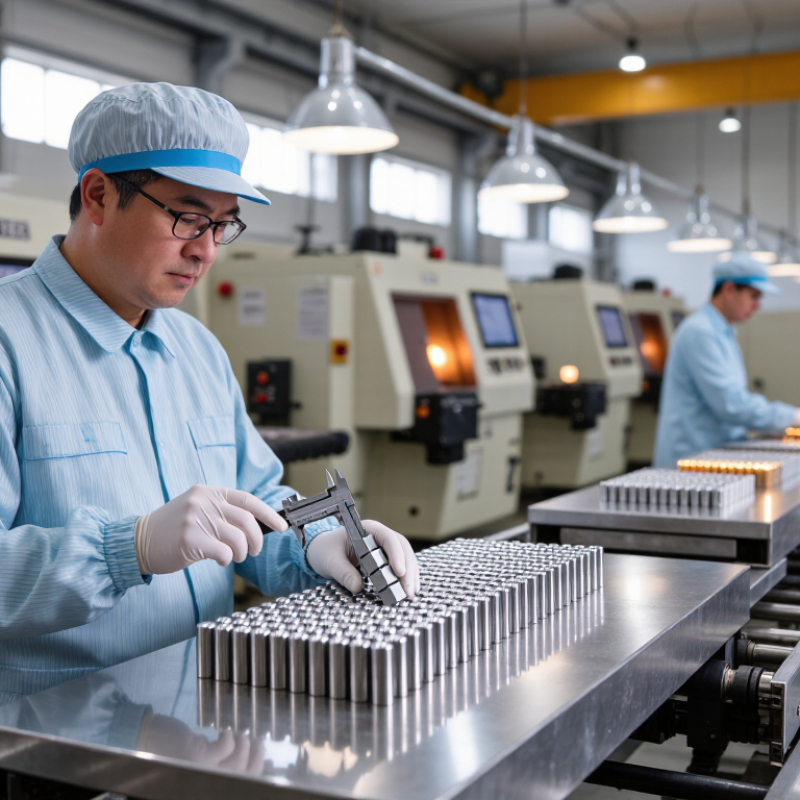
Who Is China Top Rare Earth NdFeB Permanent Magnet Supplier?

What Are NdFeB Permanent Magnets and How Are They Used?

NdFeB permanent magnets are made mainly from neodymium, iron, and boron. They produce a strong magnetic field from a remarkably compact size. This high energy density helps designers reduce motor weight, equipment volume, and power loss. A small disc magnet can hold firmly against a steel surface. However, magnetic strength is only one part of performance. Heat, corrosion, coating quality, shape, and operating conditions also matter.

These magnets support many everyday technologies. In electric motors, they help convert electrical energy into controlled rotation. In wind generators, they support efficient power production. Smaller grades appear in speakers, sensors, magnetic couplings, medical equipment, and automated machinery. Each application needs a different balance of holding force, temperature resistance, size, and cost. Engineers should examine demagnetization risk, not only the headline strength value. A magnet that performs well at room temperature may weaken in a hot motor.

When evaluating a China-based supplier, buyers should request material grades, magnetic test curves, dimensional tolerances, coating data, and batch traceability. Reliable manufacturers usually explain testing methods instead of offering vague promises. Sample inspection is essential. Check surface finish, hole position, polarity, and actual pull force. One overlooked detail can delay assembly. It is also wise to discuss packaging, because brittle magnets may chip during transport. Specifications can still be misunderstood, especially when test conditions differ. My practical view is simple: compare measured performance under real working temperatures, not just catalog numbers.
Why Is China a Leading NdFeB Magnet Manufacturing Hub?

Who Is China Top Rare Earth NdFeB Permanent Magnet Supplier?

China is a leading NdFeB magnet manufacturing hub because its advantage covers the entire supply chain. The country combines rare earth mining, separation, alloy production, pressing, sintering, machining, and coating. According to the USGS Mineral Commodity Summaries 2024, China produced about 240,000 metric tons of rare earth oxide equivalent in 2023, from a global total near 350,000 tons. This material access supports stable large-scale production.

The IEA’s Global Critical Minerals Outlook 2024 estimated that China held about 91% of global refined rare earth output and roughly 94% of permanent magnet manufacturing capacity. These figures explain its competitive pricing and fast delivery. Experienced factories can adjust grain size, magnetic strength, corrosion resistance, and temperature performance for motors, robotics, and wind turbines. Yet scale is not everything. Quality can vary between batches, especially when recycled feedstock or rushed sintering is involved. That point deserves more attention.

Tips: Buyers should request BHmax, coercivity, temperature coefficients, dimensional tolerance, coating tests, and batch-level inspection records. Ask for samples under real operating temperatures. Cheap magnets may become expensive after failure. Verify the data. Also compare lifecycle performance, not only purchase price.

Who Is China Top Rare Earth NdFeB Permanent Magnet Supplier? - Why Is China a Leading NdFeB Magnet Manufacturing Hub?

Data Dimension China’s Position or Indicative Data Why It Matters for NdFeB Manufacturing Data Basis
Rare-earth mine production Approximately 270,000 metric tons of rare-earth-oxide equivalent in 2024, compared with about 390,000 metric tons globally. A large domestic raw-material base supports supply security and reduces dependence on imported feedstock. Approx. 69% of reported global mine production; USGS 2025 estimates.
Rare-earth separation and refining China represents approximately 90% or more of global rare-earth separation and refining capacity, depending on the material and year measured. NdFeB production requires high-purity neodymium, praseodymium, dysprosium, and terbium inputs. IEA estimates for global rare-earth refining capacity.
Permanent-magnet manufacturing share China produces approximately 94% of the world’s permanent magnets, according to recent industry assessments. A concentrated manufacturing ecosystem provides mature production know-how, specialized equipment, and established supply chains. IEA Global Critical Minerals Outlook 2024; market-share estimates vary by product definition.
Typical NdFeB composition Common sintered grades contain roughly 25–35% rare-earth elements, about 0.8–1.2% boron, and iron as the balance, with other additions depending on grade. Composition can be adjusted for magnetic strength, corrosion resistance, coercivity, and operating temperature. Typical industry formulations; exact composition varies by grade and application.
Available magnetic performance Commercial sintered NdFeB materials commonly range from approximately 26 to 52 MGOe, depending on grade and manufacturing process. High energy density enables smaller and lighter motors, generators, sensors, speakers, and magnetic assemblies. Typical published grade ranges; 1 MGOe is approximately 7.96 kJ/m³.
Temperature capability Standard grades are commonly used below approximately 80–150°C, while high-temperature grades can be designed for approximately 180–230°C or higher under specified conditions. Grade selection is essential for electric motors, automotive systems, industrial equipment, and renewable-energy generators. Typical application ranges; actual limits depend on grade, geometry, coating, and magnetic circuit.
Production process chain Mining → separation → metal production → alloying → hydrogen decrepitation or milling → pressing → sintering → machining → coating → magnetization. The availability of nearly every process step in one manufacturing region improves lead-time control and process coordination. Standard sintered NdFeB industrial process flow.
Product customization capability Common shapes include discs, blocks, rings, arcs, countersunk parts, and precision assemblies; coatings include nickel-based, epoxy, zinc, and other systems. Broad processing capability supports application-specific dimensions, tolerances, corrosion protection, and magnetization directions. Common commercial NdFeB product formats and finishing options.
Quality-control requirements Key controls include chemical composition, magnetic properties, dimensional tolerances, coating thickness, corrosion resistance, and temperature stability. Consistent testing is necessary because small variations in density, orientation, or heat treatment can affect final magnetic performance. Common quality requirements for permanent-magnet procurement and industrial qualification.
Main demand sectors Electric vehicles, wind-power generators, industrial motors, automation equipment, consumer electronics, medical devices, and energy-efficient appliances. Large domestic demand encourages production scale, equipment investment, technical specialization, and faster product development. Established global applications for NdFeB permanent magnets.
Overall manufacturing-hub advantage Integrated raw materials, refining, alloy production, magnet processing, engineering talent, equipment supply, and downstream demand. This combination helps support competitive pricing, scalable output, short internal supply chains, and a wide range of custom specifications. Industry structure summarized from USGS, IEA, and standard NdFeB manufacturing practices.

Note: Market-share figures are rounded estimates and may differ according to the year, product scope, production capacity, or measurement method used. NdFeB grade performance and composition should be confirmed against the applicable technical datasheet.

Who Are the Main NdFeB Permanent Magnet Suppliers in China?

China’s main NdFeB permanent magnet suppliers are concentrated in established manufacturing regions, especially Jiangsu, Zhejiang, Guangdong, and Jiangxi. These companies usually serve automotive motors, industrial automation, wind power, speakers, and medical equipment. Most large suppliers offer sintered NdFeB magnets in grades from standard energy products to high-temperature materials.

The strongest suppliers normally control several stages internally. These include alloy preparation, powder processing, pressing, sintering, machining, coating, and magnetic testing. This control can reduce size variation and improve delivery stability. Ask for actual inspection records, not only a polished catalog. Important details include Br, Hcj, dimensional tolerance, coating thickness, and operating temperature.

Traceability matters.

A reliable supplier should explain how it manages dysprosium or terbium additions, surface protection, and batch identification. Nickel-copper-nickel coatings are common, while epoxy options may suit humid environments. Samples should match mass production, including hole position, corner radius, and magnetization direction. A sample can look excellent and still hide weak temperature performance. That is an easy mistake.

Buyers should also examine production capacity, export experience, packaging methods, and response speed after delivery. Low prices may reflect lower-grade raw materials or loose tolerances. However, high prices do not automatically prove superior quality. Independent testing remains useful, especially for motor applications where heat and vibration expose small defects. Supplier selection should follow documented evidence, not confident promises.

How to Evaluate China’s Top NdFeB Magnet Supplier?

Who Is China’s Top Rare Earth NdFeB Permanent Magnet Supplier?

How to Evaluate China’s Top NdFeB Magnet Supplier?

A reliable supplier should explain magnetic grades in practical terms. Ask for remanence, coercivity, maximum working temperature, and energy product data. These values must match your motor, sensor, speaker, or magnetic assembly.

Ask for recent inspection reports, not only attractive catalog figures. Independent testing can verify magnetic performance, dimensions, coating thickness, and corrosion resistance. A supplier with real experience should also discuss tolerances, magnetization direction, and machining limits. Small differences may affect assembly accuracy.

Samples matter. Request samples from the same production route used for mass orders. Check surface defects, dimensions, holding force, and performance after heat exposure. A short test often reveals more than a long sales presentation.

Traceability is important. The supplier should identify material batches, inspection records, and coating processes. Clear answers build confidence. Vague answers deserve caution.

Production capacity needs careful review. Ask about tooling, sintering equipment, machining lines, and quality-control staff. A large factory is not automatically a suitable factory. I have seen impressive specifications fail during assembly because tolerances were poorly controlled.

Communication also reflects technical ability. Can the supplier respond with drawings, test conditions, and corrective actions? If every answer sounds perfect, ask harder questions. Real manufacturing includes occasional variation, and honest suppliers explain how they manage it.

Evaluate samples, documents, process control, and support together. Price alone can hide inconsistent grades, weak coatings, or unstable delivery performance.

What Trends Are Shaping China’s NdFeB Magnet Industry?

China’s NdFeB magnet industry is changing from volume-driven production toward higher performance and tighter process control. Demand is growing in electric vehicles, wind turbines, industrial robots, medical equipment, and compact motors. Engineers now request stronger magnetic energy, better corrosion resistance, and stable performance at elevated temperatures.

Quality begins with powder preparation, orientation, pressing, sintering, and machining. Small differences in oxygen levels or grain structure can affect final performance. In factory audits, buyers increasingly review furnace records, coating thickness, dimensional reports, and batch traceability. Automation is expanding, especially in inspection and sorting. It reduces variation, but it does not remove the need for skilled technicians.

Another important trend is reducing dependence on heavy rare earth additions. Manufacturers are refining grain-boundary processes to improve heat resistance with fewer expensive materials. Recycling is also receiving greater attention, although collection systems remain uneven. The picture is not perfectly smooth. Some smaller producers still struggle with consistent documentation and energy efficiency. That matters. Reliable suppliers must combine laboratory data with repeatable mass production, realistic delivery planning, and clear communication about tolerances. The best purchasing decisions may come from factory evidence, not impressive claims.

Who Is China’s Top Rare Earth NdFeB Permanent Magnet Supplier?

What Trends Are Shaping China’s NdFeB Magnet Industry?

China’s rare earth mining quota increased from 132,000 tonnes in 2019 to 270,000 tonnes in 2024, measured as rare-earth oxide equivalent. This expansion reflects stronger upstream supply capacity for materials used in NdFeB permanent magnets, including neodymium and praseodymium. However, mining quota growth does not directly represent finished magnet output, pricing, or the market share of any individual supplier.

Data source: China’s officially announced total rare earth mining control indicators, reported in tonnes of rare-earth oxide equivalent.