Why is Cerium Oxide Important in Modern Technology and Industry?
Cerium Oxide plays a crucial role in modern technology and industry. This compound has diverse applications, particularly in catalysts and polishing agents. According to a recent report by MarketsandMarkets, the global cerium oxide market is projected to reach USD 1.5 billion by 2025, reflecting its increasing importance.
In the automotive sector, Cerium Oxide is essential for catalytic converters. It helps reduce harmful emissions and improve fuel efficiency. The demand for cleaner technologies drives the need for cerium oxide. Additionally, it is used in glass polishing to achieve a flawless finish. With a market growth rate of over 6% annually, the significance of this compound continues to rise.
Despite its advantages, there are challenges. The sourcing of cerium oxide can be environmentally taxing. Balancing production with sustainability remains an ongoing issue. As cerium oxide becomes more vital, industry professionals must address these concerns to ensure responsible use. The journey of cerium oxide reflects both innovation and the need for reflection in our technological advancement.

The Role of Cerium Oxide in Catalytic Converters
Cerium oxide, or CeO2, plays a crucial role in modern catalytic converters. These devices help reduce harmful emissions from vehicles. Cerium oxide acts as an oxygen storage component. It enables the catalytic converter to function efficiently under varying conditions. This ability is vital for meeting stringent environmental regulations.
In practical terms, cerium oxide assists in the oxidation of harmful gases. It converts carbon monoxide and hydrocarbons into carbon dioxide and water. This process improves air quality significantly. The use of cerium oxide also enhances the longevity of the catalyst. However, sourcing pure cerium can be challenging, affecting availability.
Tips for those interested in sustainable technology: always consider materials' origins. Investigate how manufacturers ensure environmental protection during production. Advances in recycling cerium oxide can also contribute to sustainability. Continuous innovation in this field is essential, yet it faces several hurdles. Balancing efficiency and environmental impact remains a complex challenge.
Applications of Cerium Oxide in Glass and Ceramics Production
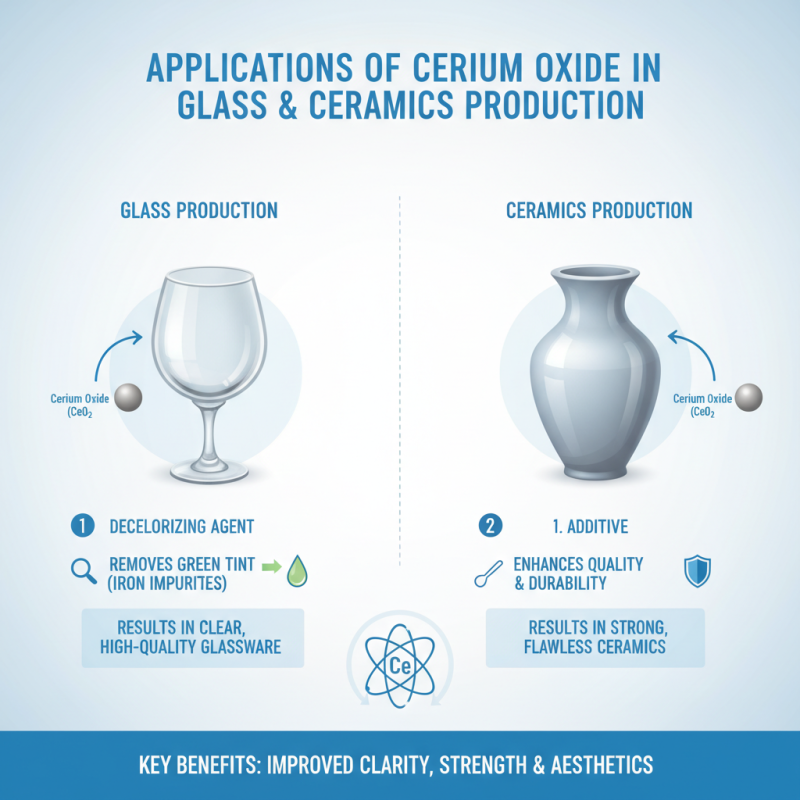
Cerium oxide plays a vital role in the glass and ceramics industry. It is used as an additive, enhancing the quality and durability of products. In glass production, cerium oxide serves as a decolorizing agent. It effectively removes the green tint caused by iron impurities. This property contributes to producing clear and high-quality glassworks.
In ceramics, cerium oxide improves surface finish and strength. It enhances the brightness and luster of ceramic materials. The compound is also crucial in developing fine-tuning glazes. However, achieving the desired consistency can be challenging. Overuse may lead to issues in the final product. Manufacturers must find the right balance.
Another application involves using cerium oxide in catalytic converters. It helps reduce harmful emissions from vehicles. Though it's an important component, its effectiveness can vary. This inconsistency prompts research for better applications and formulations. Exploring cerium oxide's potential continues to be a priority in modern manufacturing.
Cerium Oxide's Functionality in Polishing and Surface Finishing
Cerium oxide plays a crucial role in polishing and surface finishing across various industries. Its unique properties make it an ideal material for achieving high-gloss surfaces on glass, ceramics, and metals. The polishing process often requires fine abrasives to eliminate surface imperfections. Cerium oxide excels in this regard, offering a balance between aggressiveness and finesse. According to a market report by Mordor Intelligence, the global cerium oxide market is projected to reach USD 1.1 billion by 2026, highlighting its significance in industrial applications.
In optical and automotive glass manufacturing, cerium oxide is indispensable. It provides a high degree of clarity and smoothness, enhancing the visual quality of finished products. Industry studies reveal that cerium oxide polishing can improve surface roughness by up to 70%. Yet, challenges remain. Variability in cerium oxide quality can lead to inconsistent results. Manufacturers must ensure proper calibration of polishing techniques to avoid surface damage.
Environmental considerations also come into play when using cerium oxide. While it is generally regarded as safe, production processes must adhere to sustainability standards. This reflects a growing trend in industries where eco-friendly practices are critical. Balancing productivity and environmental impact is a challenge that requires constant evaluation. Companies must remain vigilant about their cerium oxide sourcing and usage to maintain both efficiency and responsibility.
Usage of Cerium Oxide in Various Industries
Influence of Cerium Oxide in Renewable Energy Technologies
Cerium oxide, a versatile compound, plays a crucial role in renewable energy technologies. This compound is pivotal in applications like catalysts for automotive emissions control and as a polishing agent in solar panels. The global cerium oxide market is projected to reach $36 billion by 2027, driven by its increasing importance in clean energy solutions.
In the renewable energy sector, cerium oxide is used in solid oxide fuel cells (SOFCs). These cells convert chemical energy into electrical energy with high efficiency. Research indicates that adding cerium oxide improves the conductivity of the electrolyte materials. This enhancement can lead to cost savings and increased durability of fuel cells. Higher efficiency translates to better overall performance in renewable energy systems.
Moreover, cerium oxide nanoparticles play a role in reducing the degradation of solar cells caused by environmental factors. Studies show that these nanoparticles can improve the stability and energy conversion rates of solar panels. Despite these benefits, challenges remain regarding the scalability of cerium oxide applications. The production processes need to be more sustainable and less resource-intensive to meet growing demands. Balancing innovation with environmental responsibility remains a key area for improvement.
Environmental Impacts and Benefits of Using Cerium Oxide
Cerium oxide (CeO2) plays a crucial role in modern technology. Its unique properties offer environmental benefits, particularly in catalysis and energy applications. For example, cerium oxide is used in catalytic converters for vehicles. This helps reduce harmful emissions, contributing to cleaner air. According to a recent study, vehicles using cerium oxide-based catalysts can lower nitrogen oxides (NOx) emissions by up to 90%.
Additionally, cerium oxide is a key component in solid oxide fuel cells (SOFCs). These fuel cells convert chemical energy into electrical energy efficiently. A report shows that integrating cerium oxide can increase the efficiency of these systems by 10%. This advancement not only enhances energy output but also supports the transition to renewable energy sources, reducing reliance on fossil fuels.
Despite these benefits, there are challenges and considerations. The extraction of cerium oxide can lead to environmental concerns. Mining processes can disturb ecosystems and generate waste. Moreover, its extensive use could lead to supply chain vulnerabilities. Balancing the advantages with potential drawbacks is essential for sustainable development. Continued research and responsible sourcing will be key to mitigating these issues while maximizing the positive impact of cerium oxide in modern industries.