Cerium Oxide, a versatile compound, plays a crucial role in various industrial applications. Its high oxygen storage capacity and catalytic properties make it valuable across numerous sectors. In this context, understanding its best uses can enhance efficiency and innovation.
In manufacturing, Cerium Oxide acts as a key component in polishing and finishing materials. It improves surface quality, making glass and ceramics shine. Additionally, its application in catalysts enhances fuel efficiency in vehicles and reduces harmful emissions. These benefits contribute significantly to sustainable practices in industrial processes.
Exploring the top applications reveals the importance of Cerium Oxide in our daily lives. However, challenges remain in its production and usage. There is a need for reflection on environmental impacts and sustainability. Developing better methods can ensure a brighter future for Cerium Oxide applications.

Cerium oxide, a rare earth metal compound, plays a pivotal role in various industrial sectors. Its significance lies in its versatility and effectiveness as an abrasive, catalyst, and polishing agent. According to industry reports, the global cerium oxide market is expected to grow at a compound annual growth rate (CAGR) of over 5% through 2028. This highlights a crucial trend in increasing demand across multiple applications.
Cerium oxide is widely utilized in the manufacturing of glass and ceramics. It serves as a polishing compound that enhances surface quality. Precision in polishing can reduce production defects, thus saving time and costs. In catalytic converters, cerium oxide acts as an oxygen storage component. It helps in mitigating harmful exhaust emissions, supporting environmental compliance measures. However, occasional inconsistencies in quality control can lead to reduced efficiency in these applications.
**Tip:** When selecting cerium oxide for industrial use, ensure the material has a consistent particle size distribution. This affects both performance and yield.
Moreover, its role in the automotive industry cannot be overlooked. Cerium oxide enhances the durability of hydrogen storage materials in fuel cells. This innovation drives forward the transition to greener alternatives. Nevertheless, the supply chain of cerium can be complex. Monitoring sourcing practices is vital to avoid disruptions.
**Tip:** Always evaluate supplier reliability. Inconsistent supply can hinder production schedules and increase costs.

Cerium oxide is gaining attention in automotive exhaust systems. Its catalytic properties help reduce harmful emissions. When used in catalytic converters, cerium oxide can facilitate reactions between pollutants and oxygen. This process leads to cleaner exhaust gases being released into the atmosphere.
In real-world applications, cerium oxide works effectively at high temperatures. However, the durability of this compound under extreme conditions can raise concerns. It may degrade over time, requiring further research. Many experts are exploring ways to enhance its stability and performance in exhaust systems.
While cerium oxide presents advantages, it is not without challenges. Its production methods can impact the environment, leading to broader discussions on sustainability. Future innovations must balance efficiency and ecological responsibility. Using cerium oxide efficiently is a promising pathway, but it needs thoughtful consideration.
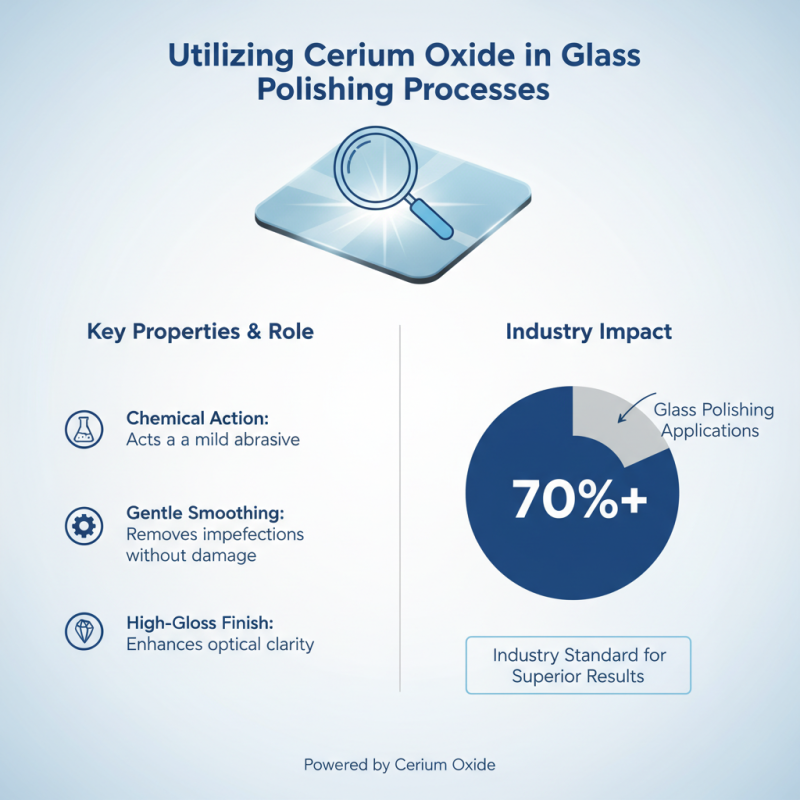
Cerium oxide plays a vital role in glass polishing processes. Its effectiveness stems from its unique chemical properties. It acts as a mild abrasive, which gently smooths surfaces without causing damage. The result? A high-gloss finish that enhances optical clarity. Recent industry reports indicate that cerium oxide is used in over 70% of glass polishing applications.
In many cases, achieving the perfect polish remains elusive. Users struggle with inconsistent results and varying material responses. Some report residue left on surfaces, which can be frustrating. However, cerium oxide's versatility allows for adjustments in particle size. Fine particles can create a smoother finish, while coarser ones tackle rough edges more effectively. This flexibility is crucial in industries ranging from automotive to electronics.
Environmental considerations are also at play. While cerium oxide is less toxic compared to other polishing agents, its production still raises concerns. Sourcing cerium responsibly remains a challenge. The industry must reflect on sustainable practices to ensure long-term viability. In the face of demand, balancing efficiency and environmental impact is essential.
Cerium oxide plays a critical role in the production of photovoltaic cells. This compound enhances the efficiency of solar panels. Recent studies show that integrating cerium oxide can increase energy conversion rates by around 5-10%. Such improvements are significant in a world that increasingly relies on renewable energy.
In manufacturing, cerium oxide serves as an effective dopant and stabilizer. It helps maintain the structural integrity of the solar cells. Solar cells need stability to endure harsh environmental conditions. However, the cost of cerium oxide can fluctuate. This variability raises questions about sustainability in large-scale production. A balance must be struck between cost and efficiency.
The global market for cerium oxide in solar energy is expanding. Reports indicate a steady growth rate of approximately 7% annually. This growth reflects the ongoing transition toward green technologies. Yet, concerns linger regarding its environmental impact. Mining and processing cerium can leave a carbon footprint. This highlights the need for responsible sourcing and usage in the industry.
Cerium oxide has gained attention for its role in water treatment. It acts as a catalyst in removing pollutants. The compound effectively improves the efficiency of filtration systems. Recent studies highlight its ability to adsorb heavy metals. It can also degrade organic contaminants. According to industry reports, the demand for cerium oxide in water purification is growing annually by 7%. This growth is largely due to increasing global water scarcity.
In urban areas, water quality issues are prevalent. Cerium oxide can help mitigate these challenges. Its unique properties allow for more efficient sedimentation processes. However, there are concerns regarding its long-term effects on ecosystems. Some studies suggest that excessive use could lead to accumulation in water bodies. This possibility raises questions about sustainability. Further research is needed to determine optimal usage levels. Striking a balance between effectiveness and environmental safety is crucial. Understanding these factors ensures that cerium oxide remains a viable solution for future water treatment needs.
| Application | Description | Benefits | Typical Uses |
|---|---|---|---|
| Water Treatment | Used as a polishing agent to remove impurities in water. | Enhances water quality by removing contaminants. | Municipal water systems, industrial wastewater. |
| Catalyst Support | Serves as a support for catalytic reactions in various chemical processes. | Increases catalyst efficiency and performance. | Petrochemical industries, exhaust systems. |
| Glass Polishing | Utilized for polishing glass surfaces to achieve clarity and shine. | Provides excellent optical quality and surface finish. | Optical devices, decorative glass. |
| Solar Cells | Used in the production of thin-film solar cells to enhance efficiency. | Improves energy conversion rates. | Photovoltaic panels, renewable energy systems. |
| Ceramic Production | Acts as a fluxing agent to enhance ceramic materials' properties. | Improves durability and aesthetic qualities. | Tableware, tiles, and sanitary ware. |
| Polishing Powders | Used in abrasives for polishing metals and stones. | Achieves high luster and smooth surfaces. | Metal finishing, jewelry making. |
| Alloys | Incorporated into metallic alloy formulations to enhance strength. | Improves mechanical properties and corrosion resistance. | Aerospace, automotive components. |
| Chemical Reagent | Used in various chemical analytical processes. | Facilitates accurate measurements and reactions. | Laboratories, industrial processes. |
| Radiological Shielding | Effective in applications needing radiation protection. | Provides safety in environments with radiation exposure. | Nuclear facilities, medical imaging. |